
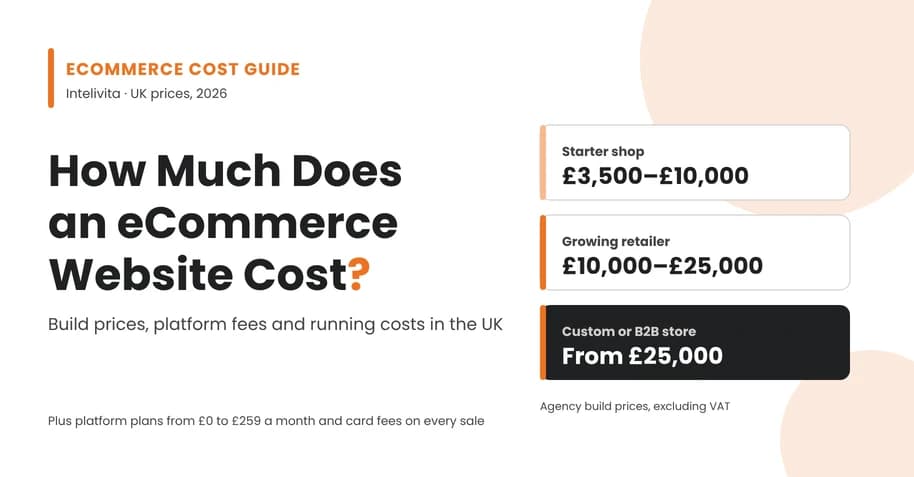
An eCommerce website built by a UK agency costs £3,500–£10,000+, excluding VAT. A shop you set up yourself on a hosted platform such as Shopify or Wix costs £0–£259 a month, plus card fees on each sale. Custom stores with ERP, stock or B2B pricing integrations cost more than £25,000.
Three things set the price: how many products and variants you sell, how much custom design you need, and which other systems the shop must connect to. Running costs continue after launch: platform fees, hosting, apps, payment fees and maintenance.
Key facts
| Question | Short answer |
|---|---|
| Agency build, UK | £3,500–£10,000+ + VAT for most shops |
| DIY on a hosted platform | £0–£259 a month, billed annually† |
| Card fees per sale | Usually 1.4%–2% + 25p on UK cards† |
| Build time | 4–16 weeks for most agency builds‡ |
| VAT registration threshold | £90,000 taxable turnover in 12 months |
| Share of UK retail sold online | 28.3% in December 2025 (ONS) |
How Much Does an eCommerce Website Cost by Store Type?
A UK eCommerce website costs £3,500–£10,000+ with an agency, excluding VAT. The final price depends on the platform you choose and how much customisation the shop needs. The same ranges apply in England, Scotland, Wales and Northern Ireland.
| Store type | Typical scope | Agency price (ex VAT) | Build time‡ |
|---|---|---|---|
| Starter shop | Hosted platform, adapted theme, up to about 100 products, standard checkout and card payments | £3,500–£10,000 | 4–8 weeks |
| Growing retailer | Custom design, product filters, subscriptions or bundles, email and delivery integrations, data migration | £10,000–£25,000 | 8–16 weeks |
| Custom or B2B store | ERP or stock system links, trade pricing, multiple currencies, headless or bespoke build | From £25,000, quoted per project | 4 months or more |
A starter shop suits a business testing online sales with a small range. A growing retailer needs a design that matches its brand and connections to the tools it already uses. A custom or B2B store is for businesses whose orders, prices or stock come from another system.
What Is Included in the Price of an eCommerce Website?
An agency quote covers discovery, design, build, product set-up, payments and delivery, testing and launch.
| Stage | What it covers |
|---|---|
| Discovery | Goals, product range, customer journeys and the systems the shop must connect to |
| Design | How the store looks and works: home, category, product, basket and checkout pages |
| Build | Theme or custom development, product filters, search and account pages |
| Product set-up | Importing products, variants, images and prices, or migrating them from an old shop |
| Payments and delivery | Card payments through a gateway such as Stripe or PayPal, delivery rates and tax settings |
| Testing | Checkout, payments, emails and page speed on phones and desktops |
| Launch | Domain connection, redirects from old URLs, analytics and a handover session |
Each stage in the eCommerce web development process adds time to the project, so a quote that leaves one out is cheaper only on paper. Hosting, platform fees, apps and product photography are usually priced separately.
How Much Do eCommerce Platforms Cost in the UK?
Hosted eCommerce platforms in the UK cost £0–£259 a month on annual billing. Monthly billing costs up to 40% more. You also pay a card fee on every sale, and some platforms add a transaction fee if you use another payment provider.
| Platform | Plans that can sell (annual billing, per month) | UK card fee on own payments | Extra fee with another provider |
|---|---|---|---|
| Square Online | Free £0, Plus £20, Premium £64 | 1.4% + 25p | Not applicable |
| Squarespace | Basic £12, Core £17, Plus £29, Advanced £79 | Payment provider rate applies | 2% on Basic, 0% on Core and above |
| Wix | Core £16, Business £25, Business Elite £119 | Payment provider rate applies | None charged by Wix |
| Shopify | Basic £19, Grow £49, Advanced £259 | 2% + 25p, 1.7% + 25p, 1.5% + 25p | 2%, 1%, 0.6% |
| BigCommerce | Priced in US dollars, from $29 | Depends on gateway | Up to 2% with some providers |
| WooCommerce | Free WordPress plugin | Depends on gateway | None |
WooCommerce has no monthly fee, but you pay for hosting, a domain, a theme and paid extensions. The cost of running a WooCommerce shop on WordPress depends mostly on those four items. Magento, now Adobe Commerce, suits large catalogues; its licence is quoted by Adobe, and the open-source version needs specialist developers and hosting.
The cheapest plan is rarely the cheapest option over a year. A Shopify shop taking £5,000 a month through an outside payment provider pays £100 in extra fees on Basic and £50 on Grow. Grow costs £30 a month more, so it saves £20 a month at that level of sales. Price is one factor; how Shopify, WooCommerce, BigCommerce and Wix compare on features and fit matters as much.
What Affects the Cost of an eCommerce Website?
The cost of an eCommerce website rises with the size of the catalogue, the amount of custom design, the number of features and the systems the shop connects to. Platform choice sets the starting point.
Number of Products and Variants
A larger catalogue costs more to set up, filter and test. A shop with 50 products and no variants can use a theme's standard layout. A shop with 5,000 products in several sizes and colours needs bulk import, product filters and stronger search.
Design Complexity
Design complexity is the look, feel and level of detail of an eCommerce website. A pre-made theme is cheaper than a fully custom design. The number of unique page designs, the use of graphics and illustrations, and custom interface elements all add design time.
Features and Functionality
Features are the tools your shop offers customers and staff, such as product listings, a basket, checkout, accounts and wish lists. Standard features come with the platform. Subscriptions, product builders, trade accounts and loyalty schemes need apps or custom code, and each one adds cost.
Third-Party Integrations
Third-party integrations connect your shop to other services, such as payment providers, couriers, accounting software and a CRM. A ready-made app connection is quick to add. A link to an ERP or stock system that has no ready-made app needs custom development, which is often the largest single cost in a B2B build.
Data Migration
Moving from an old shop means transferring products, customers and past orders, then redirecting old URLs. Redirects protect the search rankings the old pages have earned. A clean export from a common platform takes days; a messy or custom database can take weeks.
Security and Payments
Security measures protect customer data, especially payment details. Hosted platforms include an SSL certificate, server security and updates in the monthly fee. Taking card payments through a hosted checkout from Stripe, PayPal or Shopify Payments keeps card data off your server and reduces your PCI DSS work. A self-hosted shop, such as WooCommerce, needs paid hosting with security monitoring and regular plugin updates.
Is It Cheaper to Build an eCommerce Website Yourself, Use a Freelancer or Hire an Agency?
Building the shop yourself is cheapest in cash but costs the most time. Build it yourself if you have the skills, time and a small product range. Hire a developer if the shop needs custom design, integrations or a migration, or if your time is better spent running the business.
| Route | Cash cost | Best for | Main risk |
|---|---|---|---|
| DIY on a hosted platform | £0–£259 a month plus apps and card fees | Small range, standard checkout, owner with time to learn | Slow launch and a shop that looks like many others |
| Freelancer | Quoted per project or by day rate | Theme set-up, small changes, one clear task | Gaps in cover for design, testing or support if one person is unavailable |
| Agency | £3,500–£10,000+ + VAT for most shops | Custom design, integrations, migration, ongoing support | Higher upfront cost |
Building the shop yourself gives you full control over design and set-up, and it suits a tight budget. Hiring a developer costs more but saves time and reduces mistakes in checkout, tax settings and redirects. An eCommerce website development team also covers design, testing and support under one contract.
How Much Does an eCommerce Website Cost to Run Each Year?
An eCommerce website costs a few hundred pounds a year to run on a basic hosted plan, and several thousand pounds once it has paid apps and a support plan. Card fees come on top and grow with sales.
| Running cost | Typical UK cost | Notes |
|---|---|---|
| Platform plan | £0–£259 a month† | Hosted platforms include hosting and SSL |
| Hosting (self-hosted shops) | £2–£10 a month shared; £300+ a month dedicated | WooCommerce and Magento need their own hosting |
| Domain name | About £15 in the first year, then a yearly renewal | A .co.uk domain usually renews for less than a .com |
| Apps and extensions | £0–£500 a month | Reviews, subscriptions, email marketing, delivery labels |
| Card and transaction fees | 1.4%–2% + 25p per UK card sale† | Plus any platform fee for outside providers |
| Maintenance and support | £3,000–£5,000 a year with an agency (confirm) | Updates, fixes, security checks, small changes |
Budget for running costs before launch. A shop with £30,000 of yearly card sales pays about £600 in percentage fees at 2%, before the 25p charge on each order. Ongoing website maintenance and support keeps the platform, apps and checkout working after updates.
What UK Rules Affect the Cost of an eCommerce Website?
UK rules add small fixed costs and some build work, mainly to checkout, cookie consent and policy pages. Most of the cost is in setting the shop up correctly at the start.
| Rule | What your shop must do | Cost or build impact |
|---|---|---|
| VAT | Register once taxable turnover passes £90,000 in 12 months; charge 20% on most goods; show VAT-inclusive prices to consumers | Tax settings at build; VAT on an agency quote is reclaimable if you are VAT-registered |
| UK GDPR and Data Protection Act 2018 | Collect only the customer data you need, keep it secure and publish a privacy notice | ICO data protection fee: £52 (micro), £78 (small and medium) or £3,763 (large) a year |
| PECR | Get consent for non-essential cookies and for marketing emails, except where the soft opt-in applies to existing customers | A cookie consent tool, often free or a low monthly fee |
| Consumer Contracts Regulations 2013 | Give buyers 14 days to cancel most online orders and show key information before they pay | Returns flow and clear checkout pages |
| Consumer Rights Act 2015 | Goods must be of satisfactory quality, as described and fit for purpose | Accurate product pages and a returns policy |
| Electronic Commerce Regulations 2002 | Show your business name, address and contact details, and confirm orders | Footer and order confirmation emails |
| PCI DSS | Protect card data | Lowest effort with a hosted checkout from your payment provider |
VAT changes the price your customer pays, not the cost of building the shop. Set VAT rates and price display correctly at launch, because changing them after orders start is harder.
What Is the Cheapest Way to Build an Online Shop?
The cheapest way to build an online shop in the UK is Square Online's free plan, which costs £0 a month and charges 1.4% + 25p per UK card sale†. The cheapest paid plans that can sell are Squarespace Basic at £12 a month, with a 2% transaction fee, and Wix Core at £16 a month.
A free plan suits a business that is starting out with a few products and a small budget. It limits design, features and your choice of payment provider. A paid platform such as Shopify or WooCommerce gives stronger stock management, marketing tools and app connections. The higher monthly cost pays for itself once those features save staff time or win more orders.
Does an eCommerce Website Cost More Than a Regular Website?
Yes. An eCommerce website costs more than a regular website because it needs a product catalogue, basket, checkout, payments, tax settings and order emails. A brochure site has none of these, so the cost of a standard business website starts lower. The more complex the shop, the wider the gap.
How Do You Compare eCommerce Website Quotes?
Compare quotes on scope, not on the total alone. A lower quote often leaves out product set-up, migration or testing, which then appear as extra charges. Check that each quote states:
- the platform and the monthly fees you will pay after launch
- how many page designs are custom and how many use the theme
- how many products the agency will set up or import
- every integration, named, such as Xero, Royal Mail or your ERP
- redirects from your old site, if you have one
- testing on phones and desktops before launch
- who owns the design, code and content when the project ends
- what support costs after launch and what it includes
- whether the price includes VAT
FAQs
How long does it take to build an eCommerce website?
A starter shop on a hosted platform takes 4–8 weeks with an agency. A complex eCommerce site built from scratch takes 2–3 months or longer. Product data, content and integrations decide the timeline more than the design does. The stages that decide how long a website takes to build apply to online shops too, with extra time for product set-up and payment testing.
What Does It Cost to Start an Online Business in the UK?
Starting an online business in the UK costs the website plus a few fixed fees. Registering as a sole trader with HMRC is free. Registering a limited company with Companies House costs £100 online, plus £50 a year for the confirmation statement. VAT registration becomes compulsory once taxable turnover passes £90,000 in 12 months. Stock, packaging and delivery usually cost more than these fees. The steps to start an online business in the UK cover choosing a business structure, registering and launching.
How much does a Shopify website cost in the UK?
A Shopify website costs £19–£259 a month for the plan on annual billing, plus 1.5%–2% + 25p per UK card sale through Shopify Payments. An agency build on Shopify costs £3,500–£10,000++ VAT, depending on design and integrations.
How much does a WooCommerce website cost?
WooCommerce is free to install. You pay for hosting, a domain, a theme, paid extensions and the build. An agency WooCommerce build costs £5,000–£25,000 + VAT, the same range as a hosted platform.
How much does eCommerce website maintenance cost?
Agency maintenance for an eCommerce website costs about £400–£2,000 a month. It covers platform and app updates, security checks, fixes and small changes. Platform fees, apps and card fees are separate.
Do I pay VAT on an eCommerce website build?
Yes, if the agency or developer is VAT-registered: 20% is added to the quote. A VAT-registered business can usually reclaim it.
How Do You Build an eCommerce Website?
To build an eCommerce website, choose a platform, plan the product catalogue, design the store, set up payments and delivery, test the checkout, then launch with redirects and analytics. Platform choice and the number of integrations decide most of the time and cost. The eCommerce web development process explains what happens at each stage and who is involved.
Plan Your eCommerce Website Budget
Intelivita builds eCommerce websites for UK businesses. Tell us your product range, current systems and launch date, and we will send an itemised quote.