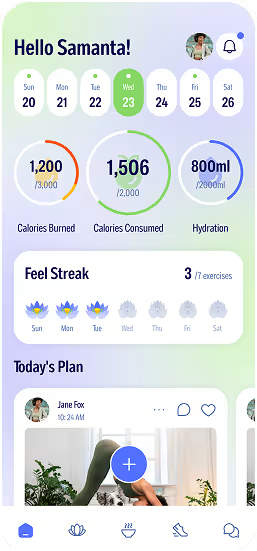
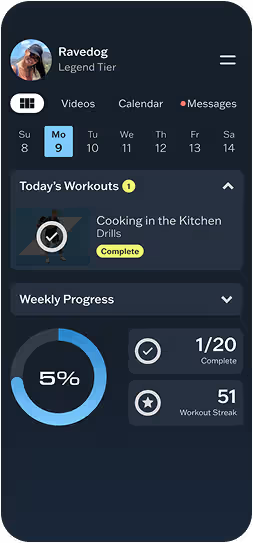
What Mobile App Testing Services Does Intelivita Offer?

The mobile app testing services that Intelivita offers include manual testing, automated testing, and iOS and Android validation, covering every stage. Our mobile testing solutions identify broken integrations, performance lags, and compatibility issues in all devices and Operating Systems (OS). QA engineers handle every testing cycle as part of our mobile app development services lineup, built to catch failures before they reach production.

Manual Mobile App Testing Services

Our manual mobile app testing services rely on QA engineers running user flows, checking touch interactions, navigation, and edge cases that scripts alone miss. We catch usability gaps and layout breaks in screen sizes. Our testers document bugs with reproduction steps and device details.

Automated Mobile App Testing Services

Intelivita provides automated mobile app testing services that run scripted test suites using Flutter, React Native, Swift, and Kotlin.We integrate the suites into CI / CD pipelines through GitHub Actions, triggering test execution the moment new code merges.Scripted cases cover login flows, payment gateways, and regression checks, catching breakages hours faster than manual re-testing.

iOS and Android App Testing Services

The iOS and Android app testing services that we offer validate platform behaviour, Apple's App Store guidelines, and Google's Play Store policies, flagging different issues. Our QA team checks native gestures and OS-level integrations. We test coverage for OS versions and hardware variations for iOS and Android mobile devices, catching crashes before submission.

Compatibility and Multi-Device Testing

We offer compatibility and multi-device testing to address device fragmentation, running builds in varying screen resolutions and RAM configurations to confirm rendering. We use device farms and cloud testing platforms to validate performance on hardware, not simulators, catching UI shifts on lower-spec devices.

Functional Testing

Intelivita’s functional testing verifies each feature works as specified, from form submissions and navigation flows to in-app purchases and third-party API calls. We check input validation, error handling, and data flow between screens, confirming the app behaves under normal and edge-case conditions on every supported device before the release cycle.

Performance, Load and Stress Testing

Performance, load and stress testing are what we provide to measure how the app behaves under real-world conditions, tracking response time, memory usage, and battery consumption in extended sessions. Our team performs load testing to simulate users hitting servers at once to find breaking points. We use JMeter and Firebase Performance Monitoring to catch issues.

Security and Vulnerability Testing

The security and vulnerability testing scans the app against the OWASP Mobile Top 10, checking for data storage, encryption, and exposed API keys. We run penetration testing on authentication flows, session handling, and network calls, flagging attacker exploits. Static and dynamic code analysis catch issues early, keeping mobile app security intact before deployment.

Regression Testing and Bug Tracking

Our regression testing and bug tracking re-run prior test cases after each code change, catching defects that new fixes accidentally reintroduce into features. We log every defect in Jira with priority fields. Bugs move through a lifecycle, from triage and assignment to fix verification, so nothing gets marked resolved without a retest on the device and OS.

Beta Testing and User Acceptance Testing (UAT)

Beta testing and User Acceptance Testing (UAT) put the near-final build in front of users through TestFlight for iOS and Firebase App Distribution for Android, outside the controlled QA environment. We gather feedback on usability, workflow gaps, and conditions (interruptions or low battery), confirming the app solves the actual problem before public release.

QA Strategy and Test Automation Consulting

Our QA strategy and test automation consulting help you decide what to test manually versus automate, based on release frequency, app complexity, and available resources. Our engineers assess existing coverage, recommend the right tools and frameworks, and build a roadmap that fits into your CI/CD pipeline without slowing releases down.

Why Choose Intelivita as Your Mobile App Testing Company?

Our QA engineers work from our Manchester and London offices, giving UK businesses direct access without offshore delays or timezone gaps.

We have over 13 years of experience in mobile app development, helping businesses test and release stable applications across multiple industries.

Companies such as Microsoft and ITV have trusted our team to deliver reliable mobile application projects and quality assurance services.

Our team has contributed to more than 250 mobile apps across healthcare, fintech, eCommerce, and other industries, testing applications with different technical requirements.

Our manual, automated, and device-specific testing follows processes backed by ISO 9001 and ISO 27001 certifications for quality management and data security.

Why choose Intelivita as your web design and development partner in the UK

What Is Our Mobile App Testing Process?

Our mobile app testing process steps are listed below.

Requirement Analysis
STEP 1

Requirement Analysis

We review app specifications, user stories, and acceptance criteria to define the testing scope.

Test Planning
STEP 2

Test Planning

We map out test cases, device coverage, and timelines based on the app's features and target platforms.

Test Case Design
STEP 3

Test Case Design

We write detailed scenarios covering functional flows, edge cases, and expected outcomes for each feature.

Manual and Automated Execution
STEP 4

Manual and Automated Execution

We run test cases by hand and through automation scripts across selected devices and OS versions.

Bug Logging and Triage
STEP 5

Bug Logging and Triage

We record defects in Jira with severity, priority, and reproduction steps, then route them to developers for resolution.

Regression Testing
STEP 6

Regression Testing

We re-run previous test cases after each fix to confirm the new code changes do not break existing features.

User Acceptance Testing (UAT) and Sign-Off
STEP 7

User Acceptance Testing (UAT) and Sign-Off

We work with clients and users to validate the app against business requirements before the build gets approved for release.

Our Mobile App Testing and QA Portfolio

Explore our mobile app testing and QA portfolio, including functional testing, automation testing, performance testing, security testing, usability testing, compatibility testing, and regression testing for Android, iOS, and cross-platform applications.

EXPLORE OUR PROJECTS

What Are Mobile App Testing Services?

+

Why Is Mobile App Testing Important Before Launch?

+

What Types of Mobile App Testing Are Available?

+

How Long Does Mobile App Testing Take?

+

How Much Do Mobile App Testing Services Cost?

+

What Is the Difference Between Manual and Automated Mobile App Testing?

+

Should You Test Both Android and iOS Apps?

+

When Should Mobile App Testing Be Performed During Development?

+

How Often Should a Mobile App Be Tested After Release?

+

What Devices and Operating Systems Should Be Included in Testing?

+

What Are the Most Common Issues Found During Mobile App Testing?

+

Can Mobile App Testing Improve App Store Ratings?

+

What Tools Are Commonly Used for Mobile App Testing?

+

How Do You Choose the Right Mobile App Testing Company?

+

What Deliverables Should You Expect from a Mobile App Testing Service?

+

Can Mobile App Testing Be Integrated into CI/CD Pipelines?

+

What Is User Acceptance Testing (UAT) for Mobile Apps?

+

Is Automated Testing Enough for Mobile Applications?

+