What Is a Single Page Application (SPA)?

Co-Founder
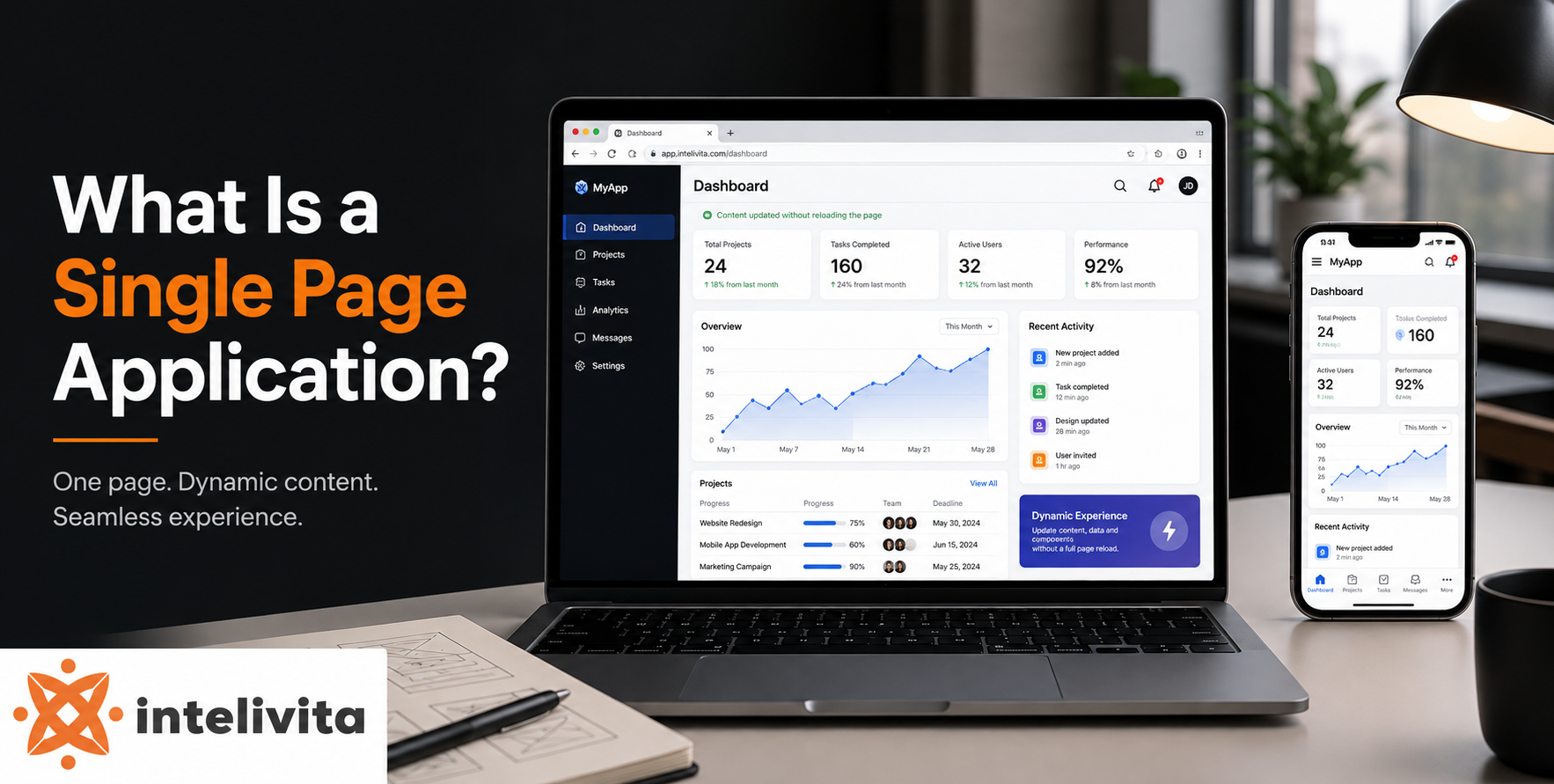
A Single Page Application (SPA) is a web application that loads a single HTML page and updates content through JavaScript, without reloading the browser for each interaction. Developers build single page apps to deliver faster navigation, reduce server requests, and create app-like experiences that keep users engaged longer.
The importance grows as UK businesses prioritise speed and usability, because a smoother interface influences conversion rates and user retention, strengthening modern web development. The approach helps companies build fast apps that handle heavy user traffic without slowing down.
How Does a Single Page Web Application Work?
A single page web application works through loading a single HTML shell, then rendering content with JavaScriptinstead of requesting new pages from the server. The browser fetches data via AJAX or Fetch API calls, and the DOM updates in real time without a full page reload, giving the interface a native app-like feel.
Client-side routing libraries (React Router or Vue Router) manage navigation, updating the URL and view state while the underlying page structure remains constant.
What Are the Key Benefits of Utilising SPA Software?
The key benefits of utilising SPA software are listed below.
- Faster Load Times: The browser downloads a single set of assets once and renders subsequent views without repeated server round-trips.
- Stable User Experience: Page transitions happen instantly through client-side rendering, eliminating flicker and full-page refreshes.
- Efficient Caching: The application stores static resources locally, reducing bandwidth consumption on repeat visits.
- Reduced Server Load: The backend serves lightweight JSON payloads via APIs instead of rendering full HTML pages for every request.
- Improved Responsiveness: JavaScript frameworks (React and Vue) update the DOM selectively, keeping interactions smooth across devices.
- Simplified Development Workflow: Front-end and back-end teams work through a decoupled API architecture, simplifying deployment cycles.
- Improved Mobile Compatibility: The app-like interface adapts to progressive web app standards, supporting offline functionality and push notifications.
What Are The Challenges of Single-Page Applications?
The challenges of single-page applications are listed below.
- SEO Limitations: Search engine crawlers struggle to index content rendered dynamically through JavaScript without proper server-side rendering.
- Initial Load Delay: The browser downloads a larger JavaScript bundle upfront, slowing the first meaningful paint.
- Browser History Complexity: Developers implement custom routing logic to preserve back-and-forward navigation behaviour correctly.
- Memory Leaks: Long user sessions accumulate unused DOM elements and event listeners, degrading performance over time.
- Security Vulnerabilities: Exposed API endpoints and client-side logic increase susceptibility to cross-site scripting attacks.
- Analytics Tracking Difficulty: Standard page-view tracking tools fail to capture route changes without additional configuration.
- Accessibility Gaps: Screen readers encounter difficulty interpreting injected content without proper ARIA attributes.
- Browser Compatibility Issues: Older browsers lack full support for modern JavaScript frameworks, limiting the user base.
Single Page App Design and Interface Best Practices
Single page app design and interface best practices build on solving the accessibility gaps and browser compatibility issues outlined earlier, since deliberate interface choices reduce the technical shortcomings. Designers implement skeleton screens and loading indicators to signal data fetching, while semantic HTML and ARIA labelling improve screen reader compatibility within the JavaScript-rendered DOM.
Consistent navigation patterns, including sticky headers and breadcrumb trails, boost browser history clarity and help users track their location despite the absence of full page reloads.
Front-End vs. Back-End Components in SPAs
Front-end and back-end components in SPAs divide responsibilities, with the front end handling UI rendering, client-side routing, state management, and user interactions through React or Vue. The back end manages authentication, database operations, business logic, and security protocols, exposing endpoints that the client consumes without direct server access to the interface layer.
The layers communicate through REST or GraphQL APIs, exchanging JSON payloads asynchronously, and developers strengthen their front-end web development skills to build the rendering logic that consumes the API responses effectively.
Managing State and Routing in a Single Page Web Application
Managing state and routing in a single-page web application relies on client-side routing libraries (React Router, Vue Router, or Angular Router), which intercept URL changes and render corresponding views without triggering full page reloads. State management separates into local state confined to components, global state shared in the application through solutions (Redux, Vuex, Pinia, or NgRx), and server state synchronised with backend data via tools (React Query or Apollo Client).
Developers maintain performance and data consistency through memoisation, selective re-rendering, and preventing stale data from propagating in connected components.
Choosing the Best Single Page Apps: Frameworks and Tools
Choosing the best single-page app depends on project scale, team expertise, and performance requirements, with React suiting large-scale applications through its extensive ecosystem and component reusability. Vue.js and Svelte serve smaller projects well, offering gentler learning curves and lighter bundle sizes, while Angular fits enterprise-grade systems requiring strict architecture and built-in tooling.
Meta-frameworks (Next.js and Nuxt) add server-side rendering for SEO benefits, and pairing tools (Vite, Redux, Tailwind CSS, Firebase, and Node.js) rounds out a scalable, developer-friendly stack.
What is the difference between an SPA and a traditional web application?
SPA is a web application that renders a single HTML shell and swaps content through JavaScript, while a traditional web application sends a fresh HTML document from the server with each navigation. Both rely on client-server communication, fetching data, processing business logic on the backend, and rendering output for the end user.
Traditional applications rebuild the entire page on every request, causing visible reloads, while SPAs keep the shell in place and update only the parts that change, making pages feel quicker to use.
What are some examples of the best single-page apps today?
The best single-page apps today are listed below.
- Gmail: Google's email client updates the inbox and message views without reloading the page.
- Facebook: The social platform loads a persistent shell while feeds, messages, and notifications refresh dynamically.
- Netflix: The streaming interface swaps content rows and video players smoothly in browsing sessions.
- Trello: The project management tool updates boards and cards in real time through drag-and-drop interactions.
- Airbnb: The booking platform renders search results and listing details instantly as users filter and navigate.
- Pinterest: The visual discovery app loads new pins continuously through infinite scroll without full page refreshes.
- Spotify: The music streaming web player updates playlists and track details while audio continues uninterrupted.
Is SEO difficult for single-page applications?
Yes, SEO is difficult for single-page applications. Search engines struggled to crawl JavaScript-rendered content, indexing empty HTML shells before scripts populated the page with text. Modern crawlers execute JavaScript before indexing, yet rendering delays and incomplete metadata still cause pages to rank lower.
Businesses running JavaScript-heavy sites address the gaps through server-side rendering, pre-rendering tools, and SEO services that optimise crawlability and data for search visibility.